

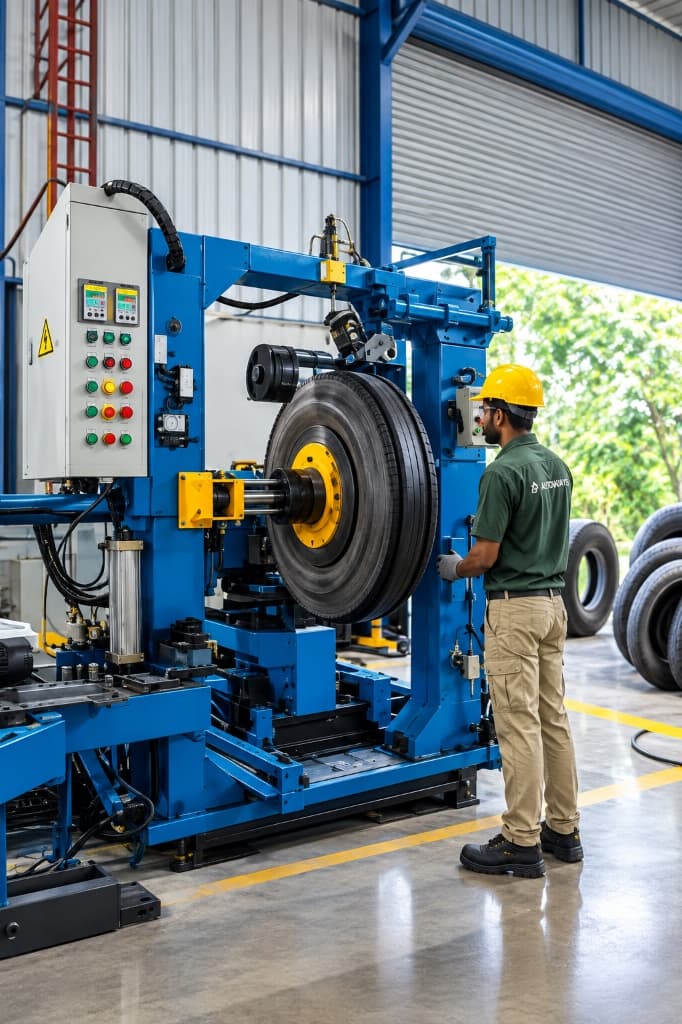
Key Highlights & Takeaways
- Tyre casings account for up to 70% of a tyre’s manufacturing cost and crude oil consumption; retreading revitalizes that investment.
- Controlled temperature Banbury mixing ensures microscopic dispersion of carbon black, silica, and curatives, resisting tropical heat degradation.
- Formulated cushion gum acts as the vital molecular bridge between buffed casing and precured tread band, preventing tread peeling under extreme braking.
- Cold retreading preserves the casing belt package integrity at lower cure temperatures, extending casing lifecycle to 2-3 additional runs.
1. The Economics & Circular Ecology of Retreading
Commercial transportation forms the economic backbone of Sri Lanka, yet fleet operators face relentless pressure from rising fuel costs, currency fluctuations, and imported tyre prices. In a conventional heavy truck or bus tyre, the steel-belted casing represents approximately 70% to 80% of the tyre’s total initial manufacturing cost and energy consumption.
Throwing away a tyre simply because the top tread has worn down to the wear bars is not only an enormous economic waste—it is an environmental tragedy. By replacing only the worn tread through certified retreading, fleet managers recover up to 85% of the tyre’s initial mileage at less than half the price of a brand-new tyre, while diverting thousands of kilograms of non-biodegradable rubber from regional landfills.
"Rebuilding Tyres. Reviving the Planet: Producing a retreaded tyre consumes up to 70% less crude oil compared to manufacturing a new commercial radial tyre."
2. Inside the Banbury Mixer: The Molecular Foundation
The performance of any retreaded tyre begins in the chemical compounding laboratory. At Autoways’ dedicated Rubber Chemical Compounding Division, raw natural elastomers and synthetic polymers are engineered to withstand the unique thermomechanical challenges of Sri Lanka’s road network.
Using industrial Banbury internal mixers under tightly regulated temperature, shear, and pressure regimes, our chemists achieve uniform microscopic dispersion of reinforcing agents (such as high-surface-area carbon black and treated silica) alongside plasticizers, anti-aging compounds, and zinc oxide curatives.
- Strict temperature controls prevent premature scorch and vulcanization degradation during primary mixing.
- High filler dispersion guarantees consistent compound density across production batches, eliminating uneven tread wear.
- Tailored formulations deliver optimal balances between abrasion resistance, wet braking grip, and rolling resistance.
3. Hot Retreading vs. Cold Retreading: Choosing the Right Solution
Modern tyre rebuilding utilizes two distinct technological pathways, each engineered for specific vehicular applications and operating environments:
Hot Retreading (Mold Cure): Unvulcanized green rubber is applied directly over the buffed casing and placed inside a high-temperature segmented steel mold. This method is ideal for heavy agricultural machinery, construction equipment, and high-stress off-road vehicles requiring seamless wrap-around shoulder protection.
Cold Retreading (Precured): A precured tread liner—already vulcanized with precision pattern molds under superior hydraulic pressure—is bonded to the buffed casing inside a flexible curing envelope at significantly lower temperatures (typically 95°C to 110°C). This lower thermal exposure protects the structural integrity of the casing cords, making it the preferred choice for long-distance logistics, container haulage, and passenger bus fleets such as the Sri Lanka Transport Board (SLTB).
4. The Unsung Hero: Formulated Cushion Gum
In precured retreading, the bond between the buffed tyre casing and the new precured tread is governed entirely by a thin layer of unvulcanized compound known as cushion gum.
If cushion gum is improperly formulated, road friction and heat build-up will cause interfacial shear failure—leading to catastrophic tread separation. Autoways produces specialized cushion gum in-house with hyper-viscous polymer chains that interlock with both the porous buffed casing and the treated underside of the precured tread band, creating a molecular weld that easily withstands tropical road surface temperatures exceeding 60°C.
5. Decades of Service: Built on Trust, Driven by Legacy
Founded in 1991 in Anuradhapura with just 12 dedicated workers during a difficult period in Sri Lanka’s history, Autoways has grown into an island-wide engineering force with over 150 employees and modern factories across Anuradhapura, Kandy (Pallekele), and Kuruwita.
Having proudly supplied and serviced the Sri Lanka Transport Board for more than two decades, our ISO 9001:2015 certified operations continue to prove that Sri Lankan engineering can match international safety, durability, and cost-efficiency benchmarks.